A mushroom dual extraction combines a hot-water decoction with an alcohol maceration, then blends the two into one tincture with a final ethanol content around 25 to 30%. That range keeps the water-soluble beta-glucans in solution while holding onto the alcohol-soluble triterpenes, so you end up with one bottle carrying both sets of compounds instead of half of them.
Here’s the fast version. Take 100 grams of dried fruiting body, split it in half. Simmer 50 grams in 500 milliliters of water for 2 to 4 hours to make your decoction. Strain both, then combine so the final blend lands at roughly 25 to 30% alcohol by volume.
Before you touch a jar, know two things. High-proof ethanol is flammable and needs to stay away from open flames, stovetops, and pilot lights. And medicinal mushroom extracts are not neutral. The Mayo Clinic recommends talking to a healthcare provider before adding concentrated mushroom extracts if you’re on medication or managing a health condition, and general nutrition guidance from Harvard’s School of Public Health treats mushrooms as a healthy food, not a drug with guaranteed effects.
Quick recipe at a glance:
- Dried mushroom: 100g total, split 50/50 between water and alcohol stages
- Water decoction: 50g in 500ml water, simmered 2 to 4 hours
- Alcohol maceration: 50g in 250ml of 95% ethanol, 4 to 8 weeks
- Final blend target: 25 to 30% ethanol by volume
Pro Tip: Weigh your dried mushroom before splitting it, not after. Moisture content varies by batch, and starting with an accurate dry weight is the difference between a tincture that hits its target potency and one that’s guessing.
If you’d rather skip the jars and the weeks of waiting, Theshroomzstore carries tested mushroom products built on the same dual-extraction logic, minus the DIY risk.
Key Takeaways
| Point | Details |
|---|---|
| Two solvents, two compound classes | Water pulls beta-glucans and polysaccharides; alcohol pulls triterpenes and phenolics. |
| Standard ratios | Use 1:4 or 1:5 dried mushroom to solvent by weight to volume for both stages. |
| Final ethanol target | Blend to 25 to 30% ethanol to keep both compound classes stable and prevent precipitation. |
| Species priority | Reishi, chaga, and lion’s mane benefit most; turkey tail and maitake do well with water extraction alone. |
| Safety first | Consult a clinician before use if on medication, and always handle high-proof ethanol away from open flame. |
| Tested alternative | Theshroomzstore offers ready-made, tested dual extracts and gummies for readers who prefer a verified potency over DIY estimation. |
This article is general information, not a substitute for advice from a qualified doctor. Consult a qualified healthcare professional about your own circumstances before acting on anything here.
Table of Contents
- Why Bother With Dual Extraction Mushrooms in the First Place?
- What You Need Before You Start
- How Do You Do the Alcohol Maceration Step?
- How Do You Do the Water Decoction Step?
- How Do You Combine the Extracts and Calculate Potency?
- Which Mushroom Species Actually Need Dual Extraction?
- How Much Should You Take, and Who Should Avoid It?
- Storing, Labeling, and Checking Your Batches
- What to Do When Your Batch Turns Cloudy or Weak
- What Does the Research Actually Say?
- A Lower-Risk Option: Ready-Made Dual Extracts
- Sources
- FAQ
Why Bother With Dual Extraction Mushrooms in the First Place?
Water and alcohol dissolve different things. That’s the entire reason this two-step process exists, and it’s why a single-solvent tincture almost always shortchanges you on something.
Hot water pulls out beta-glucans and other polysaccharides, the long-chain sugars tied to immune activity in mushroom species like reishi and turkey tail. These molecules are large and bind tightly to plant fiber, so they need sustained heat, usually a simmer well below boiling for an extended period, to break free of the cell walls. A quick steep in cold vodka won’t touch them.

Alcohol does the opposite job. Triterpenes, the bitter compounds responsible for reishi’s famous astringency, along with some phenolic compounds, dissolve in ethanol but barely move in water. Most extraction guides put the useful range between 40% and 95% ethanol depending on the target compound, with higher proof pulling more resinous, fat-soluble material. A 2025 Frontiers in Nutrition review on mushroom bioactives lists polysaccharides, terpenoids, and ergothioneine as the main classes worth extracting, and notes that which compounds you get depends heavily on extract type.
Skip the water step and you get a tincture rich in triterpenes but nearly empty of beta-glucans. Skip the alcohol step and you get the reverse: strong on immune polysaccharides, weak on the bitter compounds many people associate with reishi’s traditional use. Neither approach is wrong, exactly. They’re just incomplete.
What goes missing with single-solvent extraction:
- Alcohol-only tinctures miss the bulk of beta-glucans and water-soluble polysaccharides
- Water-only decoctions miss triterpenes, sterols, and most fat-soluble compounds
- Both approaches lose some ergothioneine, which behaves differently depending on temperature and solvent
- Single methods can’t match the full compound profile documented in species-level reviews like the 2025 MDPI Foods analysis
If your maceration smells more like a light cocktail than a bitter medicinal tea, your alcohol percentage is probably too low.*
What You Need Before You Start
Getting your ingredients and equipment lined up before day one saves you from mid-process improvising, which is where most extraction mistakes happen.
Mushroom species (dried fruiting bodies are strongly preferred over mycelium-on-grain products for extraction purity):
- Reishi (Ganoderma lucidum)
- Turkey tail (Trametes versicolor)
- Chaga (Inonotus obliquus)
- Lion’s mane (Hericium erinaceus)
- Cordyceps (Cordyceps militaris)
- Maitake (Grifola frondosa)
- Shiitake (Lentinula edodes)
Solvents and supplies:
- Food-grade ethanol, 95% for maceration (organic cane or grain alcohol, not isopropyl or rubbing alcohol)
- Filtered or distilled water for the decoction
- Optional: vegetable glycerin, for a lower-alcohol or alcohol-free variant
- Amber glass bottles and jars for storage, plus labels
Equipment checklist:
- Wide-mouth glass mason jars for maceration
- Fine mesh strainer and cheesecloth or a nut-milk bag for filtering
- A slow cooker or covered stockpot for decoction
- A kitchen scale accurate to at least 1 gram
- Optional: an ultrasonic cleaner for ultrasonic-assisted extraction, which can shorten maceration time considerably
Standard ratios run 1:4 or 1:5, meaning 1 part dried mushroom by weight to 4 or 5 parts solvent by volume. A 1:4 ratio (25g mushroom to 100ml solvent) produces a more concentrated extract; 1:5 stretches the same mushroom further but yields a slightly weaker tincture. If you’re working with powdered mushroom instead of chopped whole pieces, drop to a 1:6 or 1:7 ratio, since powder has more surface area and releases compounds faster, sometimes over-extracting bitter or resinous notes if left too long at a strong ratio.
For readers who want species-specific detail before buying, Theshroomzstore’s guide to Chaga and reishi benefits, uses, and safety covers sourcing considerations for two of the most commonly dual-extracted species.
How Do You Do the Alcohol Maceration Step?
The alcohol stage comes first in most home protocols because it’s the slower of the two steps, and it can run in the background while you plan the decoction.
Ethanol strength depends on what you’re targeting.
-
Weigh your dried mushroom. Chop or break it into small pieces, roughly pea-sized or smaller, to increase surface area. Do not use fresh mushroom here unless you account for its water content diluting your ethanol percentage.
-
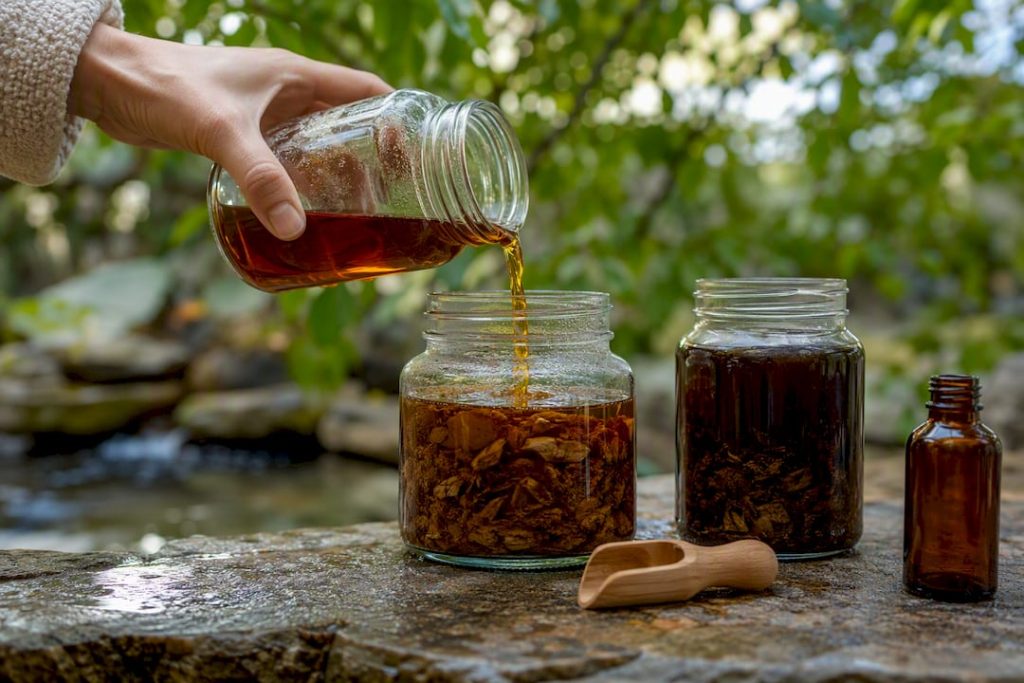
Pack the jar. Add the mushroom to a clean glass jar, then pour in ethanol at your chosen ratio (1:4 or 1:5 by weight to volume). Make sure the solvent fully covers the material with an inch to spare.
-
Seal and label. Note the species, date, ethanol percentage, and ratio directly on the jar.
-
Agitate daily. Shake the jar once or twice a day for the first two weeks to keep material from settling and to encourage even extraction.
-
Macerate for 4 to 8 weeks. Store in a cool, dark cabinet away from direct sunlight and any heat source. Reishi and chaga often benefit from the longer end of that window; lion’s mane can be ready closer to four weeks.
-
Strain. Press through cheesecloth or a nut-milk bag, squeezing out as much liquid as possible. Reserve the spent mushroom solids. You’ll use them in the water decoction stage rather than throwing them away.
If weeks of waiting doesn’t appeal to you, ultrasonic-assisted extraction (UAE) is worth researching. A PMC review of extraction technologies for mushroom bioactives found that ultrasound and other assisted methods can increase yield and cut processing time compared with passive solvent extraction, though equipment cost and technique matter for consistent results at home.
Safety matters as much as method here. Only use food-grade ethanol, ideally labeled for consumption or tincture-making, never methanol or isopropyl alcohol, which are toxic even in small amounts. High-proof ethanol vapor is flammable, so keep jars away from gas stoves, space heaters, and pilot lights while they macerate.

Pro Tip: Set a phone reminder for your daily shake during the first two weeks. After that, extraction slows down enough that shaking every few days is fine, but that early agitation window is when most of the compound transfer happens.
How Do You Do the Water Decoction Step?
Once your alcohol maceration is underway, or after you’ve strained it, it’s time to pull the water-soluble compounds out of the same mushroom material, or a fresh batch if you’d rather run both steps in parallel.
-
Combine spent solids (or fresh mushroom) with water. Use the same 1:4 or 1:5 ratio by weight, so 50 grams of mushroom to 200 to 250 milliliters of water at minimum, though many home extractors go heavier on water since some will boil off.
-
Bring to a low simmer, not a boil. Keep the temperature around 190 to 200°F. A full rolling boil can degrade some heat-sensitive compounds and also risks scorching the mushroom material if the pot runs low on liquid.
-
Simmer for 2 to 4 hours minimum. Reishi and chaga, both dense and woody, often benefit from longer simmers, up to 6 to 8 hours in staged sessions, to fully break down their tough cell structures. Lighter species like lion’s mane need less time, closer to 1 to 2 hours.
-
Check liquid levels periodically. Top off with hot water if the pot reduces too far before your target simmer time is up.
-
Reduce the volume. Once simmering is done, let the liquid reduce by roughly half to concentrate the dissolved solids. This step is optional but improves potency per milliliter.
-
Strain thoroughly. Push the liquid through a fine strainer or cheesecloth, pressing the solids to extract every bit of liquid.
-
Let cool completely before combining with alcohol extract. Combining hot liquid with your ethanol extract wastes alcohol to evaporation and can also throw off your final percentage math.
If you want a rough read on concentration, a refractometer measuring total dissolved solids (TDS) gives you a numeric sense of how much material actually made it into solution, useful if you’re trying to standardize potency across batches.
Using spent alcohol-extraction solids for the water stage is standard practice and doesn’t waste anything, since alcohol and water pull different compound classes from the same material. If you’d rather run a completely separate batch for the water stage, that works too, it just uses twice the mushroom.
Pro Tip: Don’t walk away from a simmering pot for hours at a time. A quick check every 30 to 45 minutes to top off water prevents the scorched, bitter batch that ruins an otherwise good extraction.
How Do You Combine the Extracts and Calculate Potency?
This is where a lot of home extractors get nervous, but the math is simpler than it looks. Below that range, the alcohol can’t keep the resins and triterpenes in stable solution, and you risk cloudy precipitation over time. Too far above that range, and you can actually cause the water-soluble polysaccharides to fall out of solution instead.
The formula: (volume of alcohol extract × its ethanol %) ÷ (total combined volume) = final ethanol %.
Here’s a worked example using the quantities from the earlier recipe.
| — | — | — | — |
| Alcohol extract | 200ml | 95% | 190ml pure ethanol |
| Water decoction | 200ml | — | — |
| Combined total | 500ml | — | 190ml pure ethanol |
| Final result | 500ml | 25 to 30% | Too high, needs more water decoction or added water |
This math scales to any batch size. Just keep the alcohol extract’s ethanol percentage and volume on one side of the equation and adjust your water volume until the blended total lands where you want it.
One more safety note here: reducing or concentrating alcohol extracts through evaporation to boost potency means working with concentrated ethanol vapor near heat, which is a fire risk. If you reduce alcohol volume at all, do it with gentle low heat, good ventilation, and never near an open flame.
Pro Tip: Keep a small notebook or spreadsheet with every batch’s volumes and percentages. Potency math gets easier the second and third time, but only if you can look back at what worked.
Which Mushroom Species Actually Need Dual Extraction?
Not every species benefits equally from the two-step process, and knowing which ones matter most saves you time and mushroom.
Reishi (Ganoderma lucidum) is the textbook case for dual extraction. It’s dense with both bitter triterpenes (alcohol-soluble) and beta-glucans (water-soluble), and skipping either solvent leaves out a major compound class. Reishi almost always benefits from the full dual process.
Chaga (Inonotus obliquus) is similarly triterpene-rich and needs the alcohol stage to access its full profile. A comparative extraction study on chaga found that subcritical water extraction alone produced strong polysaccharide and glucan yields, but different techniques pulled different phenolic profiles, reinforcing that method choice changes what ends up in the final extract.
Turkey tail (Trametes versicolor) leans heavily water-soluble. Most of its research interest centers on polysaccharide-K and polysaccharopeptide, both beta-glucan derivatives that extract efficiently with hot water alone. Dual extraction still adds value, but a water-only decoction covers most of what turkey tail is known for.
Lion’s mane (Hericium erinaceus) has a lighter triterpene profile than reishi or chaga, but its erinacines, compounds tied to neurological research interest, are fat and alcohol-soluble. Dual extraction is worthwhile here, though maceration times can run shorter.
Cordyceps (Cordyceps militaris) contains cordycepin, which is water-soluble, alongside some alcohol-soluble sterols. Dual extraction captures both, though water-only extracts remain popular for cordyceps specifically.
Maitake (Grifola frondosa) is best known for its D-fraction beta-glucans, heavily water-soluble. Alcohol extraction adds some value but isn’t the priority here.
Shiitake (Lentinula edodes) contains lentinan, a water-soluble polysaccharide, making a water decoction the primary extraction route, with alcohol as a secondary addition rather than a necessity.
Priority summary:
- Almost always benefits from dual extraction: reishi, chaga, lion’s mane
- Water extraction alone often sufficient: turkey tail, maitake, shiitake, cordyceps
Sourcing matters as much as species selection. Fruiting body extracts pull compounds from the actual mushroom; mycelium-on-grain products, common in cheaper supplements, often extract mostly starch from the grain substrate itself. For dual extraction at home, dried fruiting bodies give you a purer, more predictable starting material.
Pro Tip: If you’re only going to dual-extract one species to start, make it reishi. It’s the clearest demonstration of why the two-solvent method exists, since alcohol-only and water-only reishi tinctures taste and behave noticeably differently from the combined version.
How Much Should You Take, and Who Should Avoid It?
Dosing a homemade dual extract is trickier than dosing a commercial product because your concentration varies batch to batch depending on ratios, mushroom quality, and extraction time. Start conservative and adjust from there rather than assuming a standard dose will apply to your specific batch.
A common starting framework is 1 to 2 milliliters (roughly 20 to 40 drops) once or twice daily, taken under the tongue or in water or tea. Some people build up to 3 to 5 milliliters daily for species like reishi, but that’s a personal tolerance question, not a fixed target. Track how you feel over the first two weeks before increasing.
Who should be cautious or avoid concentrated mushroom tinctures entirely:
- People on anticoagulants or antiplatelet medications (warfarin, aspirin, clopidogrel), since some mushroom compounds may have mild blood-thinning effects
- People taking immunosuppressant drugs, particularly organ transplant recipients, since beta-glucans can stimulate immune activity that may interact with immunosuppressive therapy
- People on medications metabolized through CYP450 liver enzyme pathways, since some mushroom compounds may affect how those drugs are processed
- Pregnant or nursing individuals, given the lack of safety data on concentrated mushroom extracts in these populations
- Anyone with autoimmune conditions, since immune-stimulating compounds could theoretically aggravate certain autoimmune responses
This list isn’t exhaustive, and it’s exactly why the Mayo Clinic’s guidance on mushroom benefits recommends checking with a healthcare provider before adding concentrated extracts if you fall into any of these categories or manage a chronic condition.
Track adverse effects the way you would with any new supplement: note digestive changes, skin reactions, unusual fatigue, or mood shifts, and stop use if anything feels off. Homemade batches also carry a testing gap that commercial products don’t. Without lab access, you can’t verify your actual beta-glucan or triterpene content, which means dosing is always somewhat approximate. If precision matters to you, or if you’re managing a health condition where dosing accuracy is important, a third-party tested product removes that guesswork.
Pro Tip: Start any new batch at half your usual dose for the first three days, even if it’s a species you’ve taken before. Batch-to-batch potency swings are real with DIY extraction, and starting low protects you from an unexpectedly strong batch.
For readers weighing tinctures against other formats, Theshroomzstore’s guide on mushroom gummy safety covers similar interaction and dosing questions for a different delivery method.
Storing, Labeling, and Checking Your Batches
Amber glass bottles are non-negotiable for finished tinctures. Clear glass lets light degrade certain compounds over time, and amber cuts most of that exposure. Store bottles in a cool, dark cupboard, away from stove heat or direct sunlight through a window.
Shelf life depends almost entirely on your final ethanol percentage. Drop below that threshold, and shelf life shortens considerably, sometimes to a matter of months, especially if any water content remains unbalanced by preservative-level alcohol.
Signs your batch has gone bad:
- Off, sour, or musty odors that weren’t present when bottled
- Visible mold, usually white or greenish fuzz, on the surface or bottle neck
- Unusual cloudiness that develops well after bottling, distinct from normal sediment
Label every bottle with:
- Mushroom species
- Extraction ratio (1:4, 1:5, etc.)
- Batch date
- Final ethanol percentage
- Any potency notes (concentration, dilution adjustments)
If you used glycerin instead of or alongside ethanol, refrigerate the finished tincture, since glycerin-based extracts don’t carry the same antimicrobial stability as higher-proof alcohol blends.
What to Do When Your Batch Turns Cloudy or Weak
Cloudiness after combining your water and alcohol extracts usually means your final ethanol percentage sits too low to keep everything in solution.
Weak or thin-tasting extracts point to under-extraction, most commonly from too short a decoction time or mushroom pieces cut too large. Simmering longer or reducing particle size (a coffee grinder works for dried mushroom) both improve yield on a second attempt.
Variations worth trying:
- Glycerin hybrid tinctures swap some or all of the alcohol for vegetable glycerin, useful for people avoiding alcohol, though shelf stability drops and refrigeration becomes necessary
- Ultrasonic-assisted extraction (UAE) can shorten alcohol maceration dramatically compared to passive weeks-long jar extraction, though results depend heavily on equipment power and technique
- Subcritical or microwave-assisted methods exist at the research level and show promise for yield, per the PMC extraction technology review, but they require equipment well beyond typical home kitchens
Troubleshooting checklist:
- Cloudy blend: increase final ethanol percentage
- Weak potency: extend decoction time or reduce particle size
- Mold during maceration: discard the batch, don’t attempt to salvage it
- Inconsistent results between batches: standardize your weighing and timing with a written log
Pro Tip: If a batch turns cloudy right after combining but clears within a day at room temperature, that’s usually just natural settling, not a problem. Give it 24 hours before you assume something went wrong.
What Does the Research Actually Say?
The science on mushroom extraction supports the basic logic behind dual extraction, but it doesn’t hand you a guarantee of specific health outcomes, and it’s worth being clear-eyed about that gap.
On the nutritional side, observational research summarized by Harvard’s School of Public Health links regular mushroom consumption, around 18 grams a day in some studies, to lower overall cancer risk, and consuming more than two cups per week to reduced risk of mild cognitive impairment in older adults. Those findings come from dietary intake studies, not concentrated extract trials, so they speak to mushrooms as food more than to tinctures specifically.
On the compound side, the case for dual extraction is stronger. The 2025 Frontiers in Nutrition review documents polysaccharides, terpenoids, and ergothioneine as bioactive classes with antioxidant, anti-inflammatory, and immune-supportive roles, while noting that clinical evidence varies considerably by species and extract type. That variability is the whole reason this guide treats species differently rather than offering one blanket recipe.
Extraction method research backs up the idea that technique changes outcome, not just yield. The comparative work on chaga extraction methods found subcritical water extraction produced higher polysaccharide and glucan yields than other approaches, while microwave and ultrasonic methods produced different phenolic profiles entirely. That’s a direct demonstration that a lab-grade subcritical water extractor and a home stockpot decoction, while both technically “water extraction,” won’t produce identical extracts.
Key limitation worth stating plainly: most human clinical trials on medicinal mushrooms use standardized extract types, specific doses, and controlled manufacturing, conditions a home dual extraction can’t fully replicate. A homemade reishi tincture shares compound classes with the extracts used in research, but not necessarily the same concentration or ratio of active constituents.
- Nutritional and observational evidence is reasonably strong for whole mushroom consumption
- Compound-level evidence supports the biochemical logic of dual extraction (water plus alcohol captures more than either alone)
- Extraction technique measurably changes composition, confirmed across multiple mushroom species
- High-quality human trials specifically on DIY-style dual extracts remain limited, so treat wellness benefits as plausible and supported at the compound level, not clinically proven at the tincture level
A Practical Note on DIY Versus Tested Products
DIY dual extraction makes sense if you enjoy the process, want full control over species and ratios, or simply can’t access a tested product you trust. It doesn’t make sense if precise, consistent dosing matters to your situation, since home batches vary in potency more than most people realize.
Lab testing is the piece most DIY guides skip over. A commercial dual extract that’s been through third-party potency testing tells you what’s actually in the bottle. A homemade batch tells you what solvents and time you used, which is a reasonable starting point but not the same thing. If you’re using these tinctures to manage something specific, rather than as a general wellness habit, that distinction is worth weighing seriously, and a conversation with a healthcare provider before you start is still the right move either way.
A Lower-Risk Option: Ready-Made Dual Extracts
DIY dual extraction gives you full control, but it also hands you full responsibility for potency, purity, and consistency batch after batch. If that tradeoff doesn’t appeal to you, or you’d rather skip the eight-week wait entirely, Theshroomzstore’s tested mushroom products are already extracted, blended, and verified before they reach your door.

The advantage over a home batch is straightforward: you know exactly what ethanol percentage and extraction ratio went into the bottle, instead of estimating based on your own kitchen math. For readers who’d rather skip alcohol tinctures altogether, mushroom gummies formulated for daily wellness offer the same functional mushroom compounds in a format with no maceration, no measuring, and no flammable solvents to manage.
None of this replaces medical advice. If you’re managing a health condition or taking medication, talk to your healthcare provider before adding any concentrated mushroom product, homemade or store-bought. If you’re ready to skip the DIY process, browse Theshroomzstore’s tested lineup and pick the format that fits how you actually want to take your mushrooms.
Sources
- Mushrooms | The Nutrition Source | Harvard T.H. Chan School of Public Health
- PMC review on extraction technologies for mushroom bioactives
- Mushroom marvels: understanding their role in human health — Frontiers in Nutrition (2025)
- The health benefits of mushrooms – Mayo Clinic Press
FAQ
Do Mushroom Extracts Really Work?
Mushroom extracts contain compounds like beta-glucans and triterpenes with documented antioxidant and immune-supportive activity, but clinical evidence varies significantly by species and extract type, according to the Frontiers in Nutrition review. Treat them as a supportive wellness tool rather than a guaranteed remedy.
What Happens When You Start Taking Mushroom Supplements?
Most people notice gradual effects rather than immediate ones, since compounds like beta-glucans work through sustained immune and metabolic pathways. Start at a conservative dose and track how you feel over the first two weeks before adjusting.
Who Should Not Take Mushroom Supplements?
People on anticoagulants, immunosuppressants, or medications metabolized through CYP450 liver pathways should consult a healthcare provider first, as should pregnant or nursing individuals and those with autoimmune conditions. The Mayo Clinic recommends this conversation for anyone managing a chronic health condition before adding concentrated extracts.
Which Mushroom Extract Is Best?
There’s no single best species. Reishi and chaga benefit most from dual extraction because of their triterpene and polysaccharide content, while turkey tail and maitake extract effectively with water alone. Theshroomzstore’s guide to functional mushroom selection breaks down which species fit different wellness goals.
How Long Does a Dual Extraction Take Start to Finish?
The alcohol maceration stage typically runs 4 to 8 weeks, while the water decoction takes 2 to 4 hours, meaning the full process is timed by the slower alcohol step, not the water step.