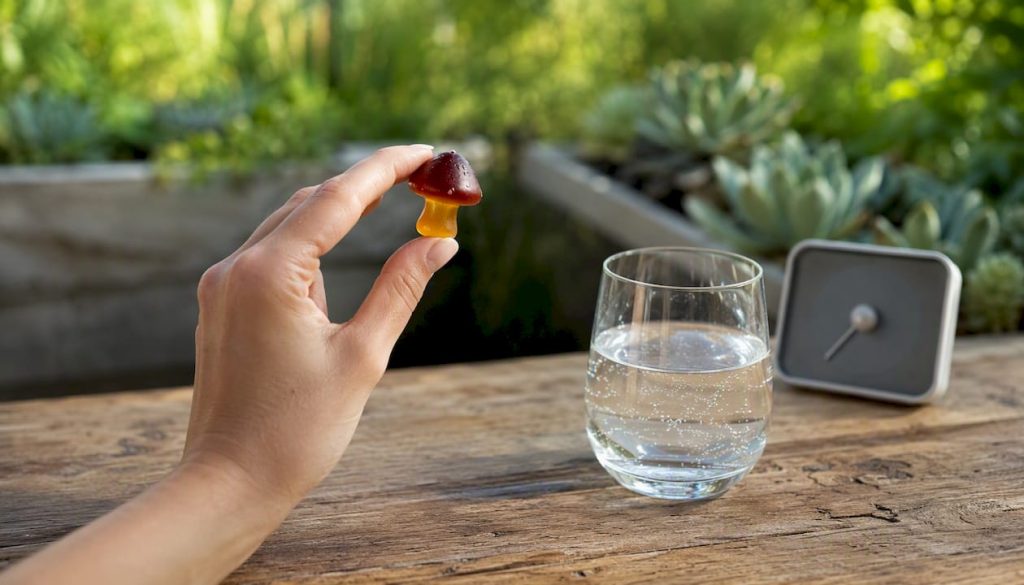
Most mushroom gummies begin producing noticeable effects within a typical window of about half an hour to an hour and a half, though the exact timing varies widely. On an empty stomach, some people feel the first signs quite quickly, while after a heavy meal, onset can be significantly delayed. That variability is the single most important thing to understand before you take your first gummy, because it is the root cause of the most common mistake: redosing too soon.
A few grounding facts before going further:
- The FDA classifies mushroom gummies as dietary supplements, not drugs. Manufacturers bear responsibility for labeling and safety monitoring, so potency and purity depend on the manufacturer’s testing practices.
- The DEA lists psilocybin as a Schedule I controlled substance at the federal level. Functional and Amanita muscaria gummies fall under different legal categories, which is important to consider for what you consume.
- Theshroomzstore emphasizes lab-tested products and a safety-first approach precisely because mushroom gummy onset is variable enough to catch even experienced users off-guard.
The core safety rule: if you do not feel effects within your expected window, do not take more. Wait the full duration before reassessing.
Key Takeaways
Mushroom gummy onset typically falls in the 30–90 minute window, but the full range runs from 20 minutes on an empty stomach to over two hours after a heavy meal, making patience before redosing the single most important safety practice.
| Point | Details |
|---|---|
| Onset window | Most psilocybin gummies kick in within 30–90 min; wait the full window before assuming nothing is happening. |
| Redosing wait time | Wait at least 3–4 hours for psilocybin gummies, 4–5 hours for Amanita, before considering any additional amount. |
| Top contraindications | Avoid if you take SSRIs, MAOIs, lithium, or antipsychotics, or have a psychotic-spectrum history or cardiovascular disease. |
| Emergency contacts | Call Poison Help (1-800-222-1222) for suspected toxic exposure; call 911 for seizures, chest pain, or loss of consciousness. |
| Legal reminder | Psilocybin is Schedule I federally; check your state and local law before consuming any psychoactive mushroom product. |
| Theshroomzstore | Offers lab-tested mushroom gummies with COAs and an extensive educational library for safer, informed use. |
Table of Contents
- How long does mushroom gummy onset take, and what is the full timeline?
- Why does mushroom gummy onset vary so much?
- What is the right dosage, and how long should you wait before redosing?
- What are the stages of a mushroom trip, and how do you recognize them?
- How do gummies compare to other forms for onset and predictability?
- What are the safety risks and medical contraindications?
- What should you do if you have a severe or distressing reaction?
- What is the legal status of mushroom gummies in the United States?
- The case for patience over precision
- Theshroomzstore: lab-tested products and honest education
- Sources
- FAQ
How long does mushroom gummy onset take, and what is the full timeline?
The timeline from swallowing a gummy to the end of the experience depends heavily on the gummy type. Functional mushroom gummies (such as lion’s mane, reishi, cordyceps) act through cumulative supplementation, producing gradual changes over days to weeks, not acute psychoactive effects in a single session.
For psychoactive gummies, the picture is more specific. A peer-reviewed pharmacology review documents psilocybin’s typical onset, peak, and duration ranges and highlights the degree of inter-individual variability in pharmacokinetics. Separately, pharmacokinetic research confirms that orally ingested psilocybin is converted to psilocin before central effects begin, with peak plasma concentrations typically aligning with the 1–2 hour window.
Here is how the three main psychoactive gummy categories compare:
| Gummy type | Onset | Peak | Total duration |
|---|---|---|---|
| Psilocybin gummies | 30–90 min (range: 20 min–2+ hrs) | 1–2.5 hrs after onset | 4–6 hrs total |
| Amanita muscaria gummies | 30–120 min | 2–3 hrs after onset | 4–8 hrs total |
| Functional gummies (lion’s mane, etc.) | Days to weeks (cumulative) | N/A (not acute) | Ongoing with consistent use |
The psilocybin arc breaks down into recognizable stages:
- Come-up (onset to 60 min): First sensory shifts, mild body heaviness, possible nausea, yawning, and early visual changes at the edges of perception.
- Peak (60–150 min): Most intense visual and cognitive effects. Time distortion is common. Emotional amplification is at its highest.
- Plateau (90–210 min): Effects level off but remain strong. Introspective thinking tends to dominate here.
- Come-down (210–360 min): Gradual return to baseline. Fatigue and emotional processing are typical.
- Afterglow (hours to next day): Residual mood lift, openness, and sometimes fatigue. Some people report clarity; others feel emotionally tender.
Amanita muscaria gummies follow a different pharmacological path entirely, relying on muscimol rather than psilocybin. The onset is often slower and the subjective character is distinct: more sedative, dreamlike, and dissociative rather than visually intense. Duration can run longer, and the dose-response curve is steeper, meaning small increases in dose produce disproportionately larger effects.
Pro Tip: Set a timer when you take your gummy. Knowing exactly when you dosed removes the guesswork when you are trying to judge whether effects have started.
Why does mushroom gummy onset vary so much?
Onset timing is not random. Several factors push it earlier or later, and most of them are within your control.
Stomach contents are the biggest variable. A high-fat meal before dosing slows gastric emptying, which delays absorption and can push onset past two hours. An empty stomach (3–4 hours fasted) tends to produce the fastest onset, often in the 20–45 minute range. A light snack lands somewhere in between.

Dose and potency matter in a compounding way. Higher doses tend to produce faster, more noticeable onset because the threshold for perceptible effects is crossed sooner. Potency varies significantly between products, and because mushroom gummies are dietary supplements not reviewed for efficacy the way drugs are, label claims are only as accurate as the manufacturer’s testing.
Gummy matrix and formulation play a subtler role. Pectin-based gummies (common in vegan products) may digest slightly differently than gelatin-based ones. The pH of the gummy, the presence of citric acid, and the encapsulation method all affect how quickly the active compounds are released in the stomach. Some formulations include absorption enhancers; most do not.
Individual metabolism is the hardest factor to predict. CYP enzyme variants affect how quickly psilocybin is converted to psilocin. Body weight, hydration status, and liver function all influence the curve. Two people taking the same gummy from the same batch can have onset times that differ by 45 minutes or more.
Tolerance compresses the perceived onset window in experienced users, not because effects begin sooner, but because they recognize subtler early signs. For first-timers, the come-up can feel sudden even when it is actually gradual.
Medications and substances can shift timing significantly. Alcohol slows gastric motility. SSRIs can blunt or delay effects. MAOIs can intensify and accelerate them dangerously. More on interactions in the safety section below.
Chewing thoroughly is a small but real factor. More surface area means faster enzymatic breakdown in the mouth and stomach. It will not move onset by an hour, but thorough mastication versus swallowing whole can shave 10–15 minutes off the come-up in some cases.
Two quick scenarios to illustrate the range: someone who takes a 2g psilocybin gummy on an empty stomach, chews it well, and has no tolerance may feel effects within 25 minutes. Someone who takes the same gummy after a large dinner, has used psilocybin twice in the past month, and takes a daily SSRI may not feel anything for 90–120 minutes, and the effects may be noticeably blunted.
What is the right dosage, and how long should you wait before redosing?
The phrase “start low and wait” is not a cliché here. It is the most effective way to avoid an unintentionally intense experience.
Dose categories for psilocybin gummies (general guidance):
- Microdose: An amount intended to be below perceptual thresholds, without acute psychedelic effects.
- Low dose: Produces mild perceptual changes, mood lift, and light sensory enhancement.
- Standard dose: Produces full psychedelic effects including visuals and significant cognitive shifts; not recommended for first-timers.
- High dose: Strong effects potentially overwhelming; appropriate only for experienced users in controlled settings with a sober sitter.
Because supplement labeling is not independently verified by a regulatory body, the milligram amount on a gummy package may not reflect actual content. Start with half the labeled dose on your first session.
Redosing wait times:
- For psilocybin gummies, wait a minimum of 3–4 hours from your first dose before considering any additional amount. The full experience has not peaked yet at the 90-minute mark, even if you feel nothing.
- For Amanita muscaria gummies, the slower and more variable onset means waiting at least 4–5 hours. Muscimol’s dose-response curve makes redosing particularly risky.
- For functional gummies, redosing within a single day is generally not a safety concern, but follow label guidance.
Session preparation checklist:
- Clear your schedule for at least 8 hours, including come-down and early afterglow.
- Choose a safe, familiar environment. Avoid crowded or unpredictable settings.
- Arrange a sober sitter if taking anything above a low dose.
- Hydrate well beforehand. Avoid alcohol for at least 24 hours prior.
- Eat a light meal 2–3 hours before, or fast for 3–4 hours if you want faster onset.
- Review your medication list. Discuss any psychiatric medications with a clinician before proceeding.
- Set an intention. Knowing why you are doing this helps anchor the experience.
For guidance on best situations for consuming mushroom gummies, including environment and timing considerations, Theshroomzstore’s educational library covers this in practical detail.
Pro Tip: Keep a dose journal. Write down the time you dosed, the amount, what you ate beforehand, and when you first noticed effects. After two or three sessions, patterns emerge that are specific to your body.
Pro Tip: A sober trip-sitter is not optional for doses above the low range. Their job is not to manage you, it is to stay calm and grounded so you have an anchor if things get intense.
What are the stages of a mushroom trip, and how do you recognize them?
Knowing where you are in the experience is the fastest way to stay calm during it. Each stage has recognizable signs, and most of what feels alarming during onset is physiologically normal.
Onset signs (first 20–60 minutes):
- Mild nausea or stomach gurgling, especially in the first 30 minutes
- Yawning, which is a common early psilocybin sign
- Slight visual brightening or sharpening at the edges of your field of view
- Mild anxiety or anticipatory nervousness
- Body heaviness or tingling in the limbs
- Pupil dilation (noticeable in a mirror)
Peak signs (60–150 minutes):
- Geometric or flowing visual patterns, especially with eyes closed
- Strong time distortion (minutes feeling like hours)
- Emotional amplification, both positive and difficult emotions
- Elevated heart rate, which is common and usually not dangerous in healthy individuals
- Difficulty with linear thinking or conversation
- Heightened sensory sensitivity to sound, light, and texture
Come-down signs (2.5–5 hours in):
- Gradual softening of visuals
- Return of linear thought
- Physical fatigue
- Emotional processing, sometimes including unexpected sadness or relief
- Appetite returning
Afterglow (5+ hours, into the next day):
- Residual mood lift or emotional openness
- Fatigue or need for sleep
- Occasionally, a sense of clarity or shifted perspective that persists for days
Physiological signposts that warrant attention but are not automatically emergencies: elevated heart rate, mild nausea, and temperature fluctuation are common. What warrants escalation: chest pain, sustained racing heart above what feels manageable, loss of consciousness, or seizures. Those are 911 situations, covered in the emergency section below.
How do gummies compare to other forms for onset and predictability?
Oral edibles are absorbed via the GI tract and generally have slower, more variable onsets than sublingual or inhaled routes. That is the pharmacological baseline for all gummies, regardless of type.
Here is how the main ingestion forms compare on onset speed and predictability:
| Form | Typical onset | Predictability | Notes |
|---|---|---|---|
| Gummies | 30–90 min | Moderate | Sugar/pectin matrix slows release; convenient dosing |
| Dried mushrooms | 20–60 min | Low to moderate | Chitin in cell walls slows absorption; highly variable potency |
| Mushroom tea | 15–45 min | Moderate to high | Faster because chitin is removed; easier on stomach |
| Capsules | 30–90 min | Moderate | Similar to gummies; no taste; dose accuracy depends on fill |
| Concentrates/extracts | 15–30 min (sublingual) | High | Fastest onset; requires precise dosing; potency is intense |

Gummies sit in the middle of the speed range. Their main advantages are consistent dose per piece (assuming good manufacturing), palatability, and portability. Their main disadvantage is the sugar and pectin matrix, which adds a digestion step before absorption begins.
Tea is faster because the hot water breaks down the mushroom cell walls before ingestion, removing the chitin barrier. Dried whole mushrooms are slower and more variable because that barrier is intact. Extracts and concentrates, particularly sublingual ones, bypass most of the GI delay entirely.
For a detailed comparison of how to take magic mushrooms across forms, Theshroomzstore’s guide covers the practical tradeoffs in depth.
When gummies are the right choice: when you want a pre-measured dose, discreet consumption, and a slower come-up that gives you time to settle in. When they are not ideal: when you need fast onset for a specific timing window, or when you are trying to minimize total sugar intake.
What are the safety risks and medical contraindications?
Mushroom gummies carry real medical risks that are not adequately communicated on most product labels. The FDA’s supplement framework means manufacturers self-certify safety, and the 2024 Diamond Shruumz outbreak made the consequences of that gap concrete: the CDC documented severe illnesses and recalls tied to mislabeled mushroom gummy products, with FDA recall actions confirming the supply-chain risk. A CDC MMWR report documented the public-health scope of that outbreak.
Who should not use psychoactive mushroom gummies:
- Anyone with a personal or family history of schizophrenia, bipolar disorder with psychotic features, or other psychotic-spectrum conditions. Psilocybin can trigger or worsen psychotic episodes.
- People currently taking SSRIs or SNRIs. Effects may be blunted or, in some cases, unpredictably altered. Never stop psychiatric medication to use psilocybin without medical supervision.
- Anyone on MAOIs. The combination can produce dangerous serotonergic effects.
- People taking lithium. The combination with psilocybin has been associated with seizure risk in case reports.
- Anyone on antipsychotic medications.
- Pregnant or breastfeeding individuals.
- People with significant cardiovascular disease, uncontrolled hypertension, or arrhythmias. Psilocybin raises heart rate and blood pressure transiently.
- Anyone under 25, given ongoing brain development.
For readers with substance-use histories, SAMHSA’s harm-minimization resources provide additional support and context.
Always look for a Certificate of Analysis (COA) from a third-party lab before purchasing any mushroom gummy product. A COA confirms what is actually in the product and at what concentration. For more on mushroom gummy safety and what to look for on a label, Theshroomzstore’s dedicated safety guide covers the specifics.
What should you do if you have a severe or distressing reaction?
Most difficult experiences with mushroom gummies are psychological, not medical emergencies. The distinction matters because the response is different.
For anxiety, panic, or a difficult psychological experience:
- Move to a quieter, dimmer space. Reduce sensory input.
- Lie down or sit comfortably. Do not try to “push through” by staying active.
- Focus on slow, deliberate breathing. Inhale for 4 counts, hold for 4, exhale for 6.
- Drink water. Sip slowly.
- If a sober sitter is present, ask them to sit quietly nearby. Physical presence without pressure is often enough.
- Remind yourself: the substance has a known duration. This will pass.
- Avoid mirrors, screens, and news. Soft music or silence works better.
For trip-sitters:
Pro Tip: Match your breathing to the person’s breathing rate, then gradually slow yours. They will often follow without realizing it. This is one of the most effective grounding tools available.
Pro Tip: Have a “comfort kit” ready: a blanket, a familiar playlist, a simple tactile object. Familiar sensory anchors reduce the disorientation that drives panic.
Call Poison Help at 1-800-222-1222 or visit PoisonHelp.hrsa.gov if:
- The person ingested an unknown substance or an unlabeled product.
- Symptoms are severe and worsening rather than plateauing.
- You suspect the product may have been contaminated or mislabeled.
- The person has a known medical condition that complicates the situation.
Call 911 immediately if:
- The person loses consciousness.
- Seizures occur.
- There is chest pain or difficulty breathing.
- The person becomes violent or poses a danger to themselves or others.
California Poison Control’s psilocybin guidance is a useful reference for US-based readers on what to expect when calling poison control and what information to have ready.
What is the legal status of mushroom gummies in the United States?
Psilocybin is a Schedule I controlled substance under federal law, meaning it is illegal to manufacture, distribute, or possess at the federal level, regardless of state or local rules. That federal status has not changed.
What has changed in some jurisdictions:
- Oregon established a regulated therapeutic psilocybin program under Measure 109.
- Colorado passed Proposition 122, creating a regulated access framework for natural medicine, including psilocybin.
- Several cities including Denver, Oakland, Santa Cruz, and Washington D.C. have decriminalized possession of psilocybin mushrooms, meaning local law enforcement has deprioritized prosecution.
Amanita muscaria gummies occupy a different legal space. Muscimol and ibotenic acid are not scheduled under the federal Controlled Substances Act, making Amanita products legal to sell in most US states, though individual state laws vary.
How to verify your local status:
- Check your state legislature’s website for current statutes on psilocybin and controlled substances.
- Review your city or county’s municipal code for decriminalization ordinances.
- Consult the DEA’s controlled substances list for federal scheduling.
- For legal questions specific to your situation, consult a licensed attorney in your state.
The bottom line: check local law before consuming any psychoactive mushroom product. Federal scheduling means federal risk exists regardless of local decriminalization, and the legal picture continues to evolve.
The case for patience over precision
There is a version of the mushroom gummy conversation that focuses almost entirely on optimizing onset, as if the goal is to engineer the fastest possible come-up. That framing misses the actual risk. The people who end up in difficult situations are rarely the ones who waited too long. They are the ones who dosed, felt nothing at 45 minutes, and took more.
The variability in mushroom gummy onset is not a flaw to be corrected with better products or tighter protocols. It is a feature of oral pharmacology that no formulation has fully solved. Even well-made, lab-tested gummies from a reputable source can produce onset times that differ by an hour between two sessions with the same person. Metabolism, stress, sleep, and what you ate three hours ago all move the needle.
What this means practically: the wait is the dose strategy. Sitting with uncertainty for 90 minutes is not a failure of the experience. It is the experience. The people who handle that window best are the ones who prepared their environment, told someone where they were, and committed to not redosing before the window closed.
Theshroomzstore’s educational approach is built around exactly this: not just selling products, but giving people the information to use them without ending up on the wrong side of a delayed onset. That combination of lab-tested sourcing and honest education is rarer than it should be in this space.
Theshroomzstore: lab-tested products and honest education

Theshroomzstore is built for people who want to use mushroom products without guessing. Every product in the catalog is selected with lab testing and COA transparency as baseline requirements, not optional extras. The educational library covers onset timing, dosing, safety, and legal context in depth, so you are not piecing together information from unreliable sources before a session.
For readers who want a vetted starting point, the safety-first wellness guide walks through product selection with the same conservative, evidence-grounded approach this article takes. Browse the catalog, read the COAs, and start with a dose that gives you room to learn before you go further.
Sources
The following resources were used to shape this article and are worth bookmarking for ongoing reference:
This article is general information, not a substitute for advice from a qualified doctor. Consult a qualified healthcare professional about your own circumstances before acting on anything here.
FAQ
Do mushroom gummies work immediately?
No. Most psilocybin gummies take 30–90 minutes to produce noticeable effects, with onset as fast as 20 minutes on an empty stomach and as slow as 2+ hours after a heavy meal. Functional mushroom gummies (lion’s mane, reishi) work cumulatively over days to weeks, not within a single session.
What time of day should you take mushroom gummies?
Morning or early afternoon is generally preferred for psychoactive gummies, since the full experience plus afterglow can run 6–8 hours. Taking them late in the day risks the peak and come-down overlapping with nighttime, which can disrupt sleep and reduce the ability to rest during the afterglow.
What are the stages of a mushroom trip?
A psilocybin experience typically moves through come-up (first sensory changes, mild nausea, anxiety), peak (strongest visuals and cognitive shifts), come-down (fatigue, emotional processing), and afterglow (residual mood changes). Each stage has recognizable physiological and psychological signs that help you track where you are in the arc.
How long do shroom gummies last in total?
Psilocybin gummies typically produce effects lasting 4–6 hours from onset to baseline, with afterglow effects potentially continuing into the following day. Amanita muscaria gummies can run 4–8 hours given muscimol’s longer duration and slower dose-response curve.
Is it safe to redose if you feel nothing after an hour?
No. One hour is within the normal onset window for psilocybin gummies, especially after eating. Redosing at that point risks a double dose hitting simultaneously once digestion catches up. Wait at least 3–4 hours from your initial dose before making any decision about taking more.