
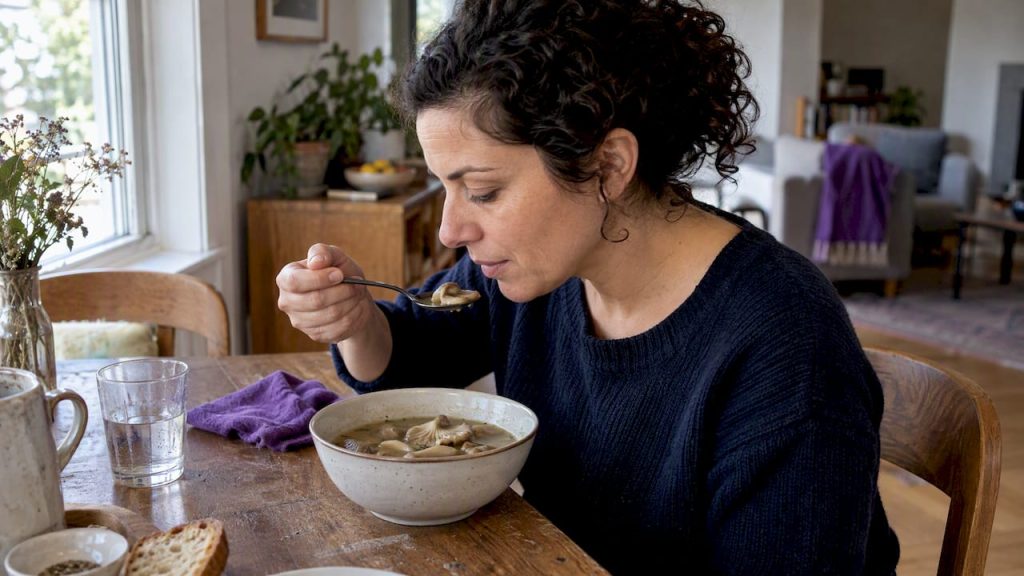
Systematic reviews and recent randomized controlled trials find that mushrooms do not reliably lower LDL or total cholesterol, though triglycerides have shown more consistent improvement across several human trials. Mushrooms can still support a heart-healthy eating pattern recommended by the American Heart Association, but they are not a substitute for prescribed lipid-lowering medication.
TL;DR:
- In a shiitake bar trial lasting 66 days, triglycerides fell 10%, while participants’ LDL and total cholesterol showed no significant change.
- A separate oyster mushroom trial used 30 grams of dried mushrooms daily for 21 days; triglycerides fell, but total cholesterol only trended lower.
- A trial over eight weeks paired 84 grams of mixed mushrooms daily with a Mediterranean diet; researchers attributed cholesterol changes to the overall diet.
- Use mushrooms to replace some red or processed meat in an eating pattern recommended for heart health, rather than as cholesterol therapy.
- Because human trials have not tested drug interactions, people taking lipid medication should consult a clinician before adding concentrated mushroom supplements or changing treatment.
Table of Contents
- What the Research Actually Shows at a Glance
- Why Mushrooms Could Plausibly Affect Lipids
- Human Trial Evidence by Mushroom Species
- How to Add Mushrooms if You Want Heart Benefits
- Safety Notes and Regulatory Cautions
- What People Report Anecdotally About Mushrooms and Cholesterol
- Mushrooms and Cholesterol Medications: What to Know
- Mushrooms Versus Oats, Nuts and Plant Sterols
- How Often and How Long to Eat Mushrooms for an Effect
- Choosing a Mushroom Product for Cholesterol Support
- Our Take on Mushrooms and Cholesterol
- Mushroom Options for a Food-First Approach
- FAQ
- Sources
What the Research Actually Shows at a Glance
Human trials on mushrooms and cholesterol paint a consistent picture once you strip away the marketing noise. The systematic review of 22 human articles found that mushroom consumption generally had a neutral effect on LDL, total cholesterol and HDL, while triglycerides improved more consistently across studies.
Three species account for nearly all the human evidence:
- Oyster mushroom (Pleurotus ostreatus), tested as dried mushrooms in soup and as standardized powder.
- Shiitake (Lentinula edodes), tested as compressed nutrition bars over a 66-day trial.
- White button (Agaricus bisporus), tested alongside oyster mushroom within an 8-week Mediterranean-style diet.
A 2021 randomized trial found a 10% drop in triglycerides among participants eating shiitake bars daily for 66 days, though LDL and total cholesterol did not move significantly. An earlier oyster mushroom trial using 30 grams of dried mushrooms in soup for 21 days produced a similar pattern: triglycerides and oxidized LDL dropped, but total cholesterol only trended lower without reaching significance, as reported in a systematic review of oyster mushroom trials.
The practical takeaway is simple: treat mushrooms as a food swap within an AHA-style dietary pattern, not as a standalone therapy for high LDL.
Why Mushrooms Could Plausibly Affect Lipids
The theory behind mushrooms and cholesterol rests on a handful of compounds, each with a different strength of evidence behind it.
Beta-glucans are one of the compounds discussed in relation to mushrooms and cholesterol. Mushroom beta-glucans differ structurally from those in oats and barley. Cereal beta-glucans form a thick, viscous gel in the gut that physically traps bile acids and cholesterol, forcing the liver to pull more LDL from the blood to make new bile. Mushroom beta-glucans have a different branching structure, but the human trial evidence has not established an LDL-lowering effect.
Ergosterol and other fungal sterols are the second piece. In theory, these plant-like sterols can compete with dietary cholesterol for absorption in the gut, similar to how plant sterols and stanols work. Some mushroom species also contain compounds structurally related to lovastatin, a statin-like molecule, though this evidence comes mostly from laboratory and animal research rather than confirmed human outcomes.
A few points matter for anyone trying to connect lab findings to a grocery list:
- Whole and dried mushrooms deliver fiber and sterols intact, while extracts or isolated powders concentrate specific compounds and behave differently in the body.
- Preparation method, including cooking time and whether mushrooms are eaten whole or blended, affects how much beta-glucan and sterol content survives into the final dish.
- Dose matters: trials testing meaningful amounts of fungal beta-glucans still found no LDL change, which suggests the dose itself is not the only limiting factor.
- Human trials have tested different durations, but it remains unclear whether longer mushroom consumption would produce a lipid effect.
Pro Tip: Mechanistic plausibility is not the same as proof. A compound that lowers cholesterol in a test tube or in mice does not automatically do the same thing once it passes through human digestion.
The honest summary is that mushrooms contain several compounds with a biologically believable link to cholesterol metabolism, but the human trial evidence remains mixed, often limited by small sample sizes and short durations.
Human Trial Evidence by Mushroom Species
Here is what the actual trials tested, in what amounts, for how long, and what they found.
Oyster mushroom (Pleurotus ostreatus) has the longest track record. A 2011 randomized trial gave 20 adults aged 20 to 34 a soup containing 30 grams of dried oyster mushrooms daily for 21 days. Triglycerides dropped by 0.44 mmol/L and oxidized LDL fell by 7.2 U/mL, but total cholesterol only showed a statistical trend toward lower levels, with no measurable change in LDL or HDL.

A more recent 2026 double-blind randomized trial tested a more concentrated format: 8.4 grams per day of oyster mushroom powder, providing 3 grams per day of fungal beta-glucans, for 4 weeks. This trial found no change in LDL, total cholesterol, HDL, triglycerides, ApoA1 or ApoB. A post-hoc analysis suggested reduced cholesterol absorption, particularly in female participants, but this exploratory finding does not establish a proven cardiovascular benefit on its own.
White button (Agaricus bisporus), paired with oyster mushroom, appeared in a 2023 randomized trial of 60 adults following a Mediterranean-style diet that included 84 grams per day of mushrooms, Agaricus bisporus four days a week and Pleurotus ostreatus three days a week, for 8 weeks. Fasting glucose improved, but other cardiometabolic markers did not change independently of the overall diet pattern, and the total cholesterol reduction observed was attributed to the Mediterranean-style diet as a whole rather than to the mushrooms specifically.
| Trial | Species | Format and dose | Duration | Primary lipid outcome |
|---|---|---|---|---|
| 2011 RCT | Oyster (Pleurotus ostreatus) | 30 g dried mushrooms in soup daily | 21 days | Triglycerides down 0.44 mmol/L; oxidized LDL down 7.2 U/mL; total cholesterol trend only |
| 2026 RCT | Oyster (Pleurotus ostreatus) | 8.4 g/day powder, 3 g/day beta-glucans | 4 weeks | No change in LDL, total cholesterol, HDL or triglycerides |
| 2023 RCT | White button and oyster | 84 g/day mixed mushrooms within Mediterranean-style diet | 8 weeks | Fasting glucose improved; cholesterol change attributed to overall diet |
The pattern across all four trials is consistent: triglycerides respond more often than LDL, and the lipid changes that do appear tend to be modest and tied to the broader dietary context rather than to mushrooms in isolation.
How to Add Mushrooms if You Want Heart Benefits
If you want to apply this evidence rather than just read about it, a few practical moves line up with how the trials were actually run.
- Swap a portion of red or processed meat for a mushroom-based entrée a few times a week, mirroring the food-substitution approach used in the Mediterranean-style mushroom trial.
- Make a mushroom soup using whole dried oyster mushrooms, echoing the format used in the 2011 oyster trial rather than relying on a flavored broth with minimal mushroom content.
- Choose whole or dried culinary mushrooms over vague “mushroom blend” supplements, since the trials used clearly identified species and amounts.
- Track your lipid panel with your clinician every few months rather than expecting a noticeable shift after a single meal or a single week of eating mushrooms.
- Never stop or reduce a prescribed statin or other lipid medication without your doctor’s input, since mushrooms have not been shown to match that level of effect.
Recipe sites like Pekin the Chef offer mushroom-forward soups and mains that make it easier to turn a research format like “30 grams of dried oyster mushroom in soup” into an actual dinner instead of an abstract trial protocol.
Pro Tip: When reading a mushroom product label, look for the species name and a specific beta-glucan content in grams, not just the word “mushroom blend.” A label that discloses both lets you compare what you’re buying to what was actually tested in a clinical trial.
Our guide on choosing real mushroom beta-glucans walks through how to tell a fruiting-body extract from a grain-filler product, which matters more than most shoppers realize.
Safety Notes and Regulatory Cautions
Mushrooms are generally well tolerated, but the human trials did record some adverse effects worth knowing before you change your diet.
- In the 66-day shiitake trial, about 10% of participants sensitive to shiitake developed dermatitis, a skin reaction that can also include itching or flushing in people with an existing sensitivity.
- Watch for rash, breathing difficulty or persistent digestive symptoms after eating mushrooms or mushroom products, and stop use and contact a clinician if any of these appear.
- The FDA has issued a letter to industry stating that Amanita muscaria, its extracts, and constituents like muscimol, ibotenic acid and muscarine are not generally recognized as safe for use in conventional food and have been linked to serious adverse events. This species has no established role in cholesterol management and is a separate safety category from the culinary species discussed above.
- Commercial gummies, chocolates and extracts can vary widely in composition. A species name printed on a label does not guarantee the product matches the dose or preparation used in a clinical trial.
Anyone currently taking a statin or another lipid-lowering medication should talk to a clinician before adding concentrated mushroom supplements, since supplement potency and purity are not standardized the way a prescription drug is.
What People Report Anecdotally About Mushrooms and Cholesterol
Online forums and product reviews are full of personal accounts of people who started eating more mushrooms and later saw improved lipid panels. These stories are worth reading with some caution, since a single person’s cholesterol can shift for many reasons at once: weight change, exercise, other dietary swaps, or simply natural variation between lab draws.
Anecdotal reports tend to track what the controlled trials found rather than contradict them. People often mention lower triglycerides or a general sense of improved digestion more than dramatic LDL drops, which lines up with the trial data showing triglycerides as the more consistently responsive marker. Testimonials describing a complete reversal of high LDL from mushrooms alone are not supported by the controlled research and likely reflect other simultaneous lifestyle changes.
If you want to see whether mushrooms make a measurable difference for you personally, the only reliable approach is a documented before-and-after lipid panel alongside a clinician, not a general sense of feeling healthier.
Mushrooms and Cholesterol Medications: What to Know
No human trial reviewed here tested mushrooms directly against or alongside statins or other prescription lipid-lowering drugs, so there is no clinical evidence describing a specific interaction. That absence of data is not the same as a guarantee of safety in combination.
The more practical concern is substitution rather than interaction: someone might reduce or stop a prescribed statin believing mushrooms will cover the gap. Since mushrooms have not shown reliable LDL-lowering in controlled trials, this substitution risks losing the stronger, proven effect of medication without replacing it with anything equivalent.
If you take a statin, fibrate or other lipid medication, mention any new mushroom supplement or significant dietary change to your prescribing clinician, particularly with concentrated powders or extracts rather than whole culinary mushrooms eaten as food. This is standard practice for any new supplement, not a flag specific to mushrooms, but it matters more here given how popular mushroom products have become in the wellness space.
Mushrooms Versus Oats, Nuts and Plant Sterols
Mushrooms sit in a different evidence tier than several other well-known natural cholesterol approaches. Oat beta-glucan has a long track record of lowering LDL through its viscous, gel-forming fiber, a mechanism distinct from the lower-viscosity beta-glucans found in mushrooms. Nuts, particularly when used to replace saturated fat sources, are part of the core American Heart Association dietary guidance for cardiovascular health. Plant sterols and stanols, added to some fortified foods, work by directly competing with dietary cholesterol for absorption in the gut, a mechanism with stronger and more consistent human data than fungal sterols currently have.
Mushrooms compare most favorably on the triglyceride side, where several trials have shown measurable improvement, and on their role as a low-fat, nutrient-dense food replacement rather than as an isolated active ingredient. The practical conclusion is not that mushrooms compete with oats or plant sterols for LDL-lowering, but that they fill a different, complementary role within the same overall eating pattern.
How Often and How Long to Eat Mushrooms for an Effect
The human trials that showed any lipid change used daily mushroom intake sustained over several weeks, not occasional servings. The 2011 oyster mushroom trial used 30 grams of dried mushrooms daily for 21 days, while the shiitake bar trial ran for 66 days with daily intake.
The trials used sustained intake, but they do not establish how long someone should eat mushrooms before checking for a measurable change. The review found triglycerides improved more consistently than LDL. A single mushroom meal may not resemble the sustained intake used in the trials that reported a result.
Recheck lipids through your usual clinician-ordered panel rather than guessing from how you feel, since triglyceride and LDL changes are not something you can reliably sense day to day.
Choosing a Mushroom Product for Cholesterol Support
Not all mushroom products are built the same way, and the trial evidence only applies to products that resemble what was actually tested.
Favor whole or dried culinary mushrooms, or capsules that clearly state the species and the beta-glucan content in grams, since this is the information the clinical trials used to define their doses. A guide to beta-glucan quality explains why fruiting-body extracts differ meaningfully from mycelium-on-grain products, which can dilute the active compounds with starchy filler.
Avoid vague “proprietary mushroom blend” labeling that does not disclose species or amount, since there is no way to compare that product to a specific trial result. Our overview of mushroom capsule evidence and dosing covers how to read a supplement facts panel for this kind of transparency. For culinary use, a dedicated guide to mushroom species can help you identify which varieties match the ones studied in human trials.
Our Take on Mushrooms and Cholesterol
The honest reading of this research is that mushrooms deserve a place on your plate, not a place in your medicine cabinet. We think the gap between what gets marketed and what the trials actually show is where most people get misled: triglycerides move, LDL mostly does not, and that distinction gets flattened into vague “heart health” claims on packaging far too often.
What we find more interesting than the headline result is that some trials reported lower triglycerides with different mushroom preparations. The review found triglycerides improved more consistently than other cholesterol measures, but the evidence remains limited.
Our stance is simple: eat mushrooms as food, choose products that disclose species and amount, and treat your prescribed statin or other lipid medication as the proven tool it is rather than something mushrooms are positioned to replace.
— Jake
Mushroom Options for a Food-First Approach
If you want to build more mushrooms into your routine the way the trials did, through food rather than isolated extracts, a few formats make that easier without overstating what they can do.
- Raw mushrooms let you add mushrooms to soups and mains.
- Capsules are another format to consider.
- Edibles are another option when cooking from scratch isn’t realistic every day.

None of these products are positioned to lower your LDL on their own, and we’re not claiming otherwise. What we do offer is a wider selection and an educational library built specifically so you can match what you buy to what the research actually tested, rather than guessing from a marketing claim. Browse the raw mushroom category to start with whole culinary forms, and talk to your clinician before changing any part of a prescribed cholesterol treatment plan.
FAQ
Is there a downside to eating mushrooms regularly?
For most people, culinary mushrooms like oyster, shiitake and white button are well tolerated as part of a normal diet. A small percentage of people sensitive to shiitake can develop dermatitis, as seen in about 10% of participants in one clinical trial, so stop use and seek care if a rash or breathing symptoms appear.
What are some well-known foods that help lower cholesterol?
Oats, nuts, legumes, fatty fish and fiber-rich vegetables are core components of the dietary pattern recommended by the American Heart Association for managing cholesterol. Mushrooms can be added to this pattern as a low-fat replacement for meat, though their main measured benefit in trials has been improved triglycerides rather than LDL.
What is the most effective herb or natural ingredient for high cholesterol?
Among natural dietary approaches, oat beta-glucan and plant sterols have the strongest and most consistent human evidence for lowering LDL cholesterol. Mushroom compounds like fungal beta-glucans and sterols are biologically plausible but have shown neutral LDL effects in most controlled human trials to date.
How can I lower high cholesterol quickly and effectively?
The most effective approach combines a diet lower in saturated and trans fats with more vegetables, whole grains and fiber, alongside statin therapy when a clinician determines it’s medically indicated, according to American Heart Association guidance. Mushrooms can support this dietary pattern but have not been shown to produce rapid or independent LDL reductions on their own.
Do mushroom supplements interact with statins or other cholesterol drugs?
No human trial reviewed here has tested a direct interaction between mushroom products and statins or other lipid-lowering drugs. Mention any new mushroom supplement to your prescribing clinician, and never reduce or stop a prescribed medication based on mushroom use alone.
Sources
- Pubmed
- Pmc
- Effects of Shiitake Culinary-Medicinal Mushroom, Lentinus edodes (Agaricomycetes), Bars on Lipid and Antioxidant Profiles in Individuals with Borderline High Cholesterol: A Double-Blind Randomized Clinical Trial
- Effect of the Intake of Oyster Mushrooms (Pleurotus ostreatus) on Cardiometabolic Parameters—A Systematic Review of Clinical Trials
- Heart


