
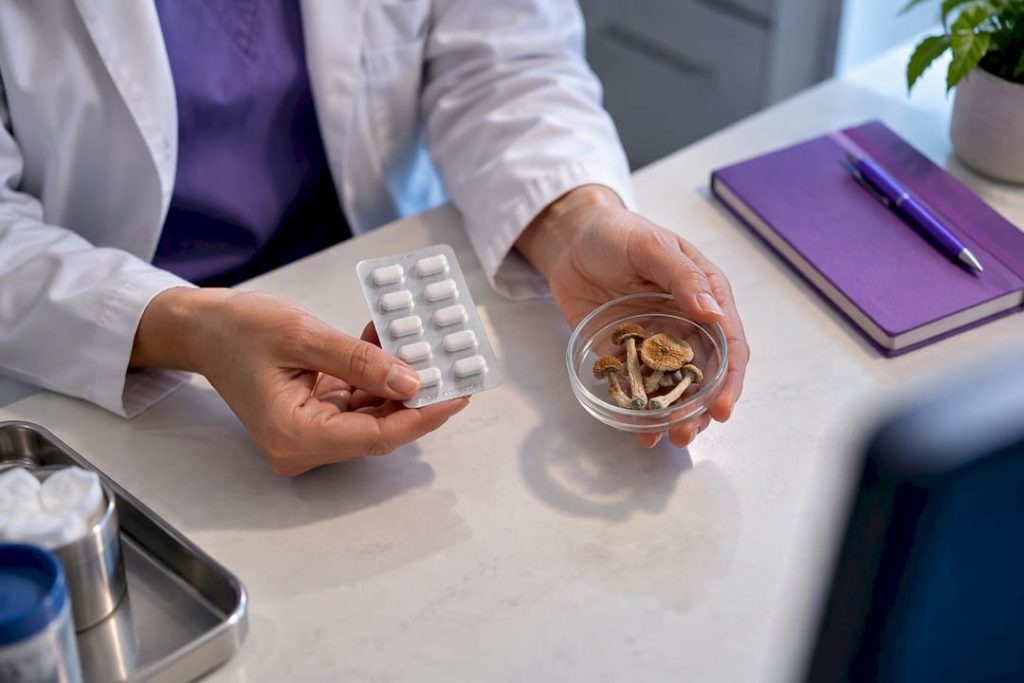
Lithium combined with psilocybin carries a documented seizure risk, and MAOIs paired with stimulants can trigger a hypertensive crisis, making these the two combinations to avoid outright. SSRIs and SNRIs rarely cause serious harm but commonly blunt psilocybin’s subjective effects. The single most useful step before using psilocybin is disclosing every medication you take to a clinician, and treating any seizure or spike in blood pressure as an emergency.
TL;DR:
- Combining psilocybin with lithium or MAOIs can cause severe adverse events such as seizures and hypertensive crises, making these combinations off-limits without medical supervision.
- SSRIs and SNRIs often blunt psilocybin’s effects, with attenuation lasting weeks or months after stopping the medication, which may lead to disappointing experiences rather than safety issues.
- The risk of cardiovascular strain increases significantly when stimulants or stimulants with MAOIs are used alongside psilocybin, especially in individuals with pre-existing heart conditions.
- Disclosing all medications, including recent changes, and planning for emergencies are essential steps before using psilocybin, particularly for those on psychiatric drugs or with health conditions.
- Long-term effects on the heart remain poorly understood, but repeated psilocybin use may carry risks related to the activity at specific serotonin receptors, especially for people with existing cardiovascular issues.
Table of Contents
- Why psilocybin interacts differently with different drugs
- How each drug class changes psilocybin’s effects and risks
- What the research and case reports actually show
- A safety checklist to work through before using psilocybin
- What psilocybin does to your heart and blood pressure
- Why this guide leans on caution over enthusiasm
- Sources
- FAQ
Why psilocybin interacts differently with different drugs
Once ingested, psilocybin is converted in the body to psilocin, the active compound responsible for its effects. Psilocin acts mainly on the 5-HT2A serotonin receptor, and how another drug in your system interacts with that receptor, or with serotonin more broadly, determines whether you get an amplified reaction, a muted one, or something dangerous.
Three distinct mechanisms explain most of what happens when psilocybin meets another substance.
- Pharmacodynamic overlap: drugs that also raise serotonin activity can theoretically stack with psilocybin’s effect on the same system, a concern behind warnings about serotonin syndrome, though severe cases tied specifically to psilocybin remain rare in the literature.
- Receptor blockade: antipsychotics and some other medications sit on the 5-HT2A receptor and can blunt or shorten psilocybin’s subjective effects because psilocin has less room to act.
- Metabolic interference: MAOIs stop the enzyme monoamine oxidase from breaking down trace amines, including phenylethylamine (PEA), a compound naturally present in mushroom material. With that enzyme blocked, PEA can build up and trigger a sympathomimetic response, meaning a surge in heart rate and blood pressure.
This third mechanism is what makes MAOIs uniquely risky. It is not that psilocybin itself becomes more potent; it is that the mushroom’s own trace chemistry, normally cleared without incident, suddenly has nowhere to go.
Chronic SSRI use tells a different story. Long-term serotonin reuptake inhibition tends to downregulate 5-HT2A receptor density and sensitivity over time. That is likely why people on SSRIs often report a weaker psychedelic experience, not because the drugs are protective against harm, but because the same receptor psilocin needs is less responsive. Attenuated effects and physiologic safety are not the same thing, and a blunted trip does not guarantee a safe one.

How each drug class changes psilocybin’s effects and risks
The evidence varies sharply by drug class, from well-documented attenuation patterns to isolated but serious case reports. Here is what the research and clinical guidance say about the classes people most often ask about.
- SSRIs and SNRIs: A large retrospective survey found these antidepressants commonly reduce psilocybin’s acute subjective effects, and the reduction can persist for weeks to months after stopping the medication. This matters most for people expecting a specific therapeutic or introspective experience, since a muted response is not a safety failure but it can be a disappointing one.
- MAOIs: These are treated as a principal pharmacologic concern in clinical guidance on psilocybin interactions, because blocking MAO-A allows trace amines in mushrooms to produce an exaggerated cardiovascular response. Anyone on an MAOI, whether prescribed for depression or as an illicit drug interaction with certain foods already avoided, should treat psilocybin as off-limits without direct medical supervision.
- Lithium: Clinical case analyses have linked lithium plus psilocybin to tonic-clonic seizures and other severe outcomes, and lithium is now widely treated as a near-absolute contraindication in psilocybin research settings.
- Antipsychotics: Many of these drugs are 5-HT2A antagonists, meaning they compete with psilocin for the same receptor. The result is usually attenuated effects, though some patients report unexpected anxiety rather than a calmer experience, an inconsistency likely tied to differences between specific antipsychotic agents.
- Benzodiazepines: These are commonly used clinically to manage acute anxiety during a psilocybin session, but they offer no protection against the pharmacologic risks posed by lithium or MAOIs. Their role is comfort, not safety net.
- Stimulants and ADHD medications: Amphetamine-type stimulants raise heart rate and blood pressure on their own, and combining them with psilocybin adds cardiovascular strain. The risk becomes severe when a stimulant is combined with both psilocybin and an MAOI, a three-way combination linked to a documented hypertensive emergency.
- Alcohol: The combination is not well studied, but alcohol’s sedative and disinhibiting effects can complicate judgment and nausea during a psilocybin experience. Most harm-reduction guidance suggests avoiding heavy drinking around dosing rather than treating light alcohol use as strictly dangerous.
- Opioids: Evidence specific to psilocybin and opioids is thin, and caution is warranted mainly because both classes affect consciousness and coordination, raising the chance of accidents rather than a specific pharmacologic clash.
- Cannabis: Commonly co-used recreationally, but cannabis can intensify anxiety or disorientation during a psilocybin experience for some people, an effect that is unpredictable rather than consistent.
Pro Tip: If you are on any psychiatric medication and unsure how it interacts, ask your prescriber before your next dose adjustment rather than experimenting to find out.
For a deeper look at how one of the most common combinations plays out, see our breakdown of psilocybin and SSRIs.
What the research and case reports actually show
The evidence base here is a mix of surveys, case reports, and emerging reviews rather than large randomized trials, and that shapes how confidently any of this can be stated.
- A scoping review of concomitant antidepressant and psychedelic use through March 2025 found that maintaining antidepressant treatment may be safer for many patients than forcing discontinuation before psilocybin use, since stopping medication abruptly can worsen depression and trigger withdrawal.
- Serious serotonin syndrome events tied specifically to psilocybin combinations were not commonly reported in that review, though the number of studies available remains limited.
- Case-report data on lithium is more alarming: one analysis found that 9 of 19 serious adverse event reports involving lithium and psilocybin included seizures or loss of consciousness.
- A 2025 case report documented a hypertensive emergency in a patient taking the MAOI tranylcypromine and the stimulant dextroamphetamine who then consumed about 1 gram of Psilocybe mushrooms.
Nearly half of SSRI users and more than half of SNRI users report a dampened psilocybin experience, with attenuation probabilities around 47% and 55% respectively in a survey of 611 respondents. That single data point explains why so many people on antidepressants describe a psilocybin experience as underwhelming rather than dangerous.
The limitations matter as much as the findings. Most of this evidence comes from retrospective surveys, isolated case reports, or small observational studies, not controlled trials. Mushroom potency and composition vary widely between batches, doses are rarely standardized, and self-reported data carries recall bias. None of this invalidates the signal that lithium and MAOI combinations are dangerous, but it does mean the full risk picture for less severe interactions is still being filled in.

A safety checklist to work through before using psilocybin
Turning this evidence into action starts with a conversation, not a dose.
- List every medication you take, including start dates, current doses, and any recent changes, and bring that list to a clinician conversation before using psilocybin.
- Disclose cardiac and seizure history, since both conditions change the risk calculus for cardiovascular strain and lithium-linked seizure events.
- Ask about your specific antidepressant rather than assuming all SSRIs or SNRIs behave the same way, since attenuation patterns and washout considerations differ by drug.
- Reconsider forced tapering: recent clinical thinking has moved away from mandatory washout periods before psychedelic use, since abrupt discontinuation can worsen depression and cause withdrawal symptoms of its own. That tradeoff is worth discussing directly with a prescriber rather than deciding alone.
- Treat lithium as an absolute stop sign and MAOI plus stimulant combinations as equally off-limits without direct medical oversight.
- Plan for emergencies in advance: know the signs of a seizure or a hypertensive crisis (severe headache, chest pain, vision changes, uncontrolled shaking) and have someone sober present who can call emergency services.
- Prepare what to report if an emergency happens: your full medication list, the approximate time and amount of mushrooms consumed, and the exact symptoms observed.
Pro Tip: Write your medication list and emergency contact on paper before dosing. In a crisis, a sober friend fumbling through your phone wastes time you may not have.
Formulation also affects how predictable a dose is, which matters when you are already managing medication interactions. Our guide to raw mushrooms versus gummies and capsules and the chocolate dosage breakdown both cover how dose variability compounds risk. For a broader overview of interaction risks beyond psychiatric medications, see psilocybin risks before use.
What psilocybin does to your heart and blood pressure
Psilocybin typically causes a transient rise in heart rate and blood pressure, and in healthy people this is usually self-limited and resolves as the acute effects wear off.
- The bigger unknown is long-term: psilocin’s activity at the 5-HT2B receptor raises theoretical concerns about valvular heart changes with repeated exposure, a signal flagged in cardiovascular safety reviews of classic psychedelics that also note how limited the data still are.
- People with unstable ischemic heart disease, uncontrolled hypertension, or arrhythmias should treat psilocybin as a genuine cardiovascular stressor and involve a cardiologist in any decision, not just a mental health provider.
- Stimulant or MAOI use on top of an existing cardiac condition compounds the risk rather than simply adding to it, since the mechanisms overlap.
Why this guide leans on caution over enthusiasm
Psilocybin’s interaction profile is not as simple as “safe” or “dangerous.” Most combinations sit in a gray zone of blunted effects and unanswered questions, while a small number, lithium chief among them, are genuinely hazardous regardless of dose or setting. The temptation in psychedelic writing is to downplay risk to make the case for wider access, but the case reports on lithium-linked seizures and MAOI-triggered hypertensive emergencies are real events involving real people, not theoretical warnings.
The honest position is that clinicians still do not have enough controlled data to give precise probabilities for most drug combinations, and that gap should make people more careful, not less. An educational library is maintained specifically because informed use starts with acknowledging what is not yet known, not just what sounds reassuring. If you take a psychiatric medication, a conversation with your prescriber will tell you more than any general guide, including this one.
— Jake
Sources
This guide draws on lithium-related case reports, the Johns Hopkins SSRI attenuation survey, a 2025 MAOI hypertensive emergency case, FDA clinical investigation guidance, and a cardiovascular safety review. Reading the primary sources is worthwhile if you want the full clinical detail.
This article is general information, not a substitute for advice from a qualified doctor. Consult a qualified healthcare professional about your own circumstances before acting on anything here.
- Case reports analysing psilocybin-lithium adverse events
- Attenuation of psilocybin mushroom effects during and after SSRIs
- Hypertensive emergency after psilocybin mushrooms with MAOI and stimulant
- Cardiovascular effects and safety of classic psychedelics
FAQ
Do psychedelics interact with medications?
Yes, psilocybin interacts with several drug classes, most notably lithium, MAOIs, and antidepressants like SSRIs and SNRIs. The severity ranges from a blunted subjective experience to serious events like seizures or hypertensive emergencies, so disclosing all medications to a clinician beforehand matters.
What are the contraindications for psilocybin use?
Lithium is considered a near-absolute contraindication due to documented seizure risk, and MAOIs combined with stimulants carry a serious hypertensive crisis risk. Uncontrolled cardiovascular conditions, including unstable ischemic disease and arrhythmias, also warrant caution and clinician involvement before use.
What drugs should not be mixed with psilocybin?
Lithium and the combination of an MAOI with a stimulant are the two highest-risk pairings, tied to seizures and hypertensive emergencies in case reports. SSRIs, SNRIs, and antipsychotics are lower risk but commonly reduce psilocybin’s effects rather than causing acute harm.
Is psilocybin hard on your heart?
Psilocybin typically causes a temporary rise in heart rate and blood pressure that resolves on its own in healthy people. Long-term cardiovascular effects, including possible valvular risk with repeated use, remain understudied according to a recent review, so people with existing heart conditions should get medical input first.
Can you mix psilocybin with alcohol?
The combination is not well studied, but alcohol’s sedative effects can worsen nausea and impair judgment during a psilocybin experience. Most harm-reduction guidance recommends avoiding heavy drinking around dosing rather than treating any alcohol use as an absolute risk.


